Oregon law requires replanting after harvest – which sometimes requires use of herbicides to ensure seedling survival
The Oregon Forest Practices Act requires re-planting of new trees within two years of harvest, and they must be “free-to-grow” within six years. That means the young trees must outcompete neighboring grass and vegetation and be growing into a healthy new forest.
When planting after harvest, foresters sometimes use herbicides to control weeds, brush and invasive species like scotch broom and blackberry that choke out new seedlings and compete for sunlight, nutrients and water. Herbicides are applied sparingly, usually one to three times in the first few years so trees can be free to grow on their own for another 40-60 years. After the first few years, herbicides are not applied again until those trees are harvested decades later and the next generation of seedlings are planted.
New Changes Make Oregon More Advanced
Herbicide applications are conducted under heavy, science-based regulation and have a strong track record for safety. The law is very clear on the safety standards for application near adjacent landowners and near streams. In 2020, forestry professionals and environmentalists worked together to craft Senate Bill 1602, which passed with nearly unanimous bipartisan support in both legislative chambers with Democrat supermajorities and was signed by Governor Kate Brown in July 2020. This historic bill continues Oregon’s long history of leadership in environmental protections for forest practices.
SB 1602 codified a groundbreaking agreement, the Private Forest Accord, between 13 timber and forest products entities and 13 environmental organizations and established additional protections for forest herbicide applications including expanded buffers, reporting requirements and notifications as outlined below.
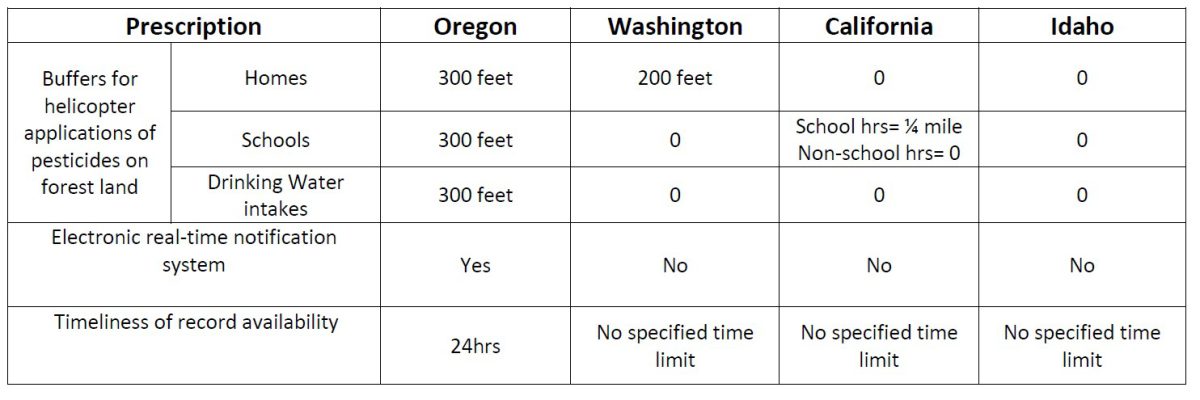
- SB 1602 requires 300-foot-wide buffers around homes, schools and water intakes for helicopter applications of pesticides on forestland.
- SB 1602 required the Oregon Department of Forestry expand its Forest Activity Electronic Reporting and Notification System to create the first ever electronic notification system for real-time communication of helicopter pesticide applications to neighbors within a mile of planned applications.
- SB 1602 requires post-application records for helicopter applications of pesticides be made available to the Oregon Pesticide Application Record Center within 24 hours and Geographic Information System records be made available within five business days.
Failure to comply with real-time notice or post-application record availability could result in a fine of up to $5,000.
In the February 2022 legislative session, Oregon legislators passed legislation that was signed into law by Governor Kate Brown codifying the most comprehensive set of changes to the Oregon Forest Practices Act since its inception fifty years ago. The set of changes resulted from more than a year of scientific review and negotiations between private forestry representatives, small forestland owners, and environmental groups, as part of the Private Forest Accord.
Included in those changes were increased streamside buffers to protect water quality for fish and drinking water. This new scientifically valid stream buffering program not only protects fish where they live, but also reduces sediment and creates continuous habitat and conservative temperature buffers in the face of climate change. Stream buffers increased by ten to 100 percent on tens of thousands of miles of forest streams, including brand new buffers for non-fish perennial streams. These no-touch buffers also serve as herbicide buffers, providing an extra layer of water quality protection.
Oregon’s new regulations mandate the largest buffers for helicopter applications of pesticides on forestland to protect homes, schools and drinking water.